
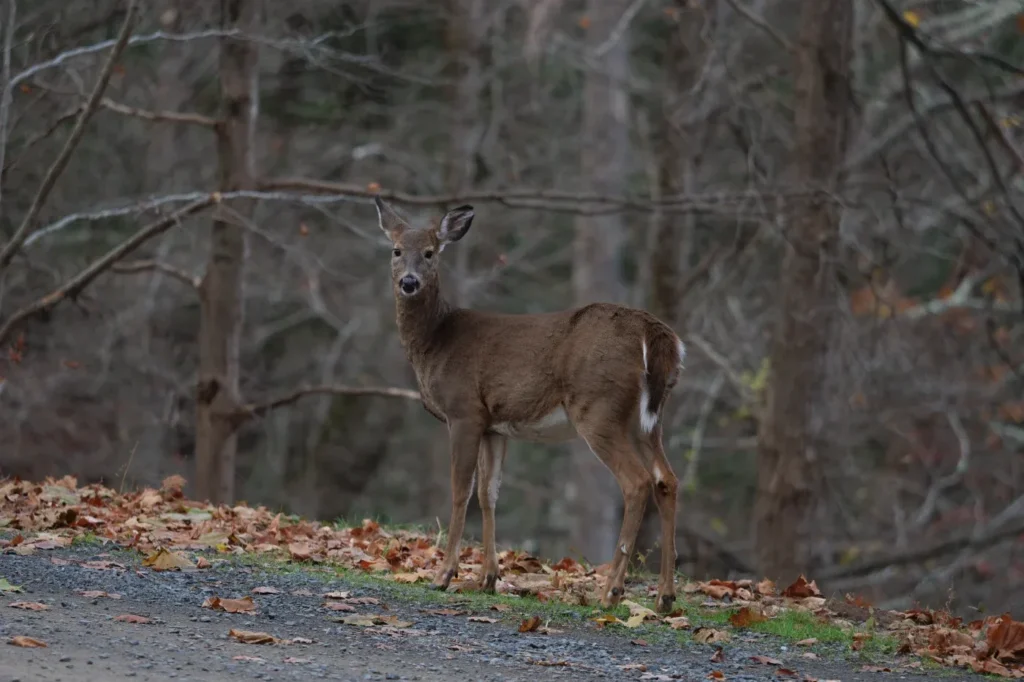
As autumn settles over the Ashokan Center, the forest becomes a place of transition. Leaves fall, daylight wanes, and across our 385 acres, the animals who share this land with us begin a quiet choreography of preparation. Some stay active, some migrate, and others disappear into the stillness of hibernation — but each plays an essential role in the ecological rhythm that defines this place.
From beavers building lodges to bald eagles patrolling the reservoir, late fall is one of the most dynamic wildlife seasons at Ashokan. Here’s how some of our most iconic species move from the abundance of fall into the demands of winter.
MAMMALS
Black Bears: Masters of the Slow-Down
Throughout fall, black bears enter hyperphagia — an almost nonstop feeding period where they bulk up for winter. At Ashokan, they forage heavily on acorns, beechnuts, berries, and whatever they can sniff out along the forest edges.
By late fall, they retreat into dens — hollow trees, rock crevices, or underground burrows — entering a state of torpor. Unlike true hibernators, bears can wake if disturbed, but their heart rate and metabolism slow dramatically, conserving energy until spring.
Beavers: Builders of Winter Security
Beavers are among Ashokan’s most industrious residents. As temperatures drop, they reinforce lodges with mud (which freezes into a protective cement) and store freshly cut branches underwater. This submerged pantry allows them to access food even when the pond surface freezes.
If you visit Ashokan’s wetlands in fall, you may spot their signature tracks, freshly chewed saplings, or ripples from their iconic tail slap.
Bobcats: Silent Winter Hunters
Bobcats remain active year-round. In fall, they expand their hunting territories, stalking rabbits, squirrels, and mice that stay active in winter. Their thick fur grows in by late autumn, and they rely on stealth and patience to survive the cold months.
Though rarely seen, their tracks — round, catlike, without claw marks — sometimes appear along Ashokan’s trails and stream edges.
River Otters: Playful Survivors
Ashokan’s otters are built for winter. Their dense fur and high metabolism keep them warm as they slip between water and ice. They don’t hibernate but spend more time hunting fish, frogs, and crustaceans. Fresh slide marks on snowy creek banks are a sure sign they’re still at play.
White-Tailed Deer: Masters of Energy Conservation
As fall shifts toward winter, deer grow their thick winter coats — hollow hairs for insulation, dark coloring to absorb heat. They reduce movement to conserve energy, frequenting sheltered forests and browsing on twigs, bark, and remaining plant life.
If you join one of Ashokan’s winter hikes, you may notice well-worn deer trails forming like quiet highways through the woods.
BIRDS
Bald Eagles: Winter Royalty of the Reservoir
Ashokan’s bald eagles remain year-round. As winter descends, their activity centers around open water — places where they can fish even when much of the reservoir freezes.
The dividing weir and aeration basin provide critical open water zones. Visitors sometimes witness adults teaching juveniles to hunt or see pairs perched high, scanning the water for trout.
American Kestrels: Tiny Falcons on the Move
Some kestrels stay through winter; others migrate south. Those that remain hunt open fields, using perches and powerlines to spot voles scurrying under light snow cover.
Loons, Grebes, Ducks & Gulls: Following the Open Water
As long as the reservoir retains unfrozen sections, these species stay — diving for fish, dabbling in shallows, or loafing along the surface.
But once deep freeze sets in, most continue their migration toward coastal waters.
Great Blue Herons: Waiting Out the Cold
Herons linger through fall but usually depart when ice prevents them from fishing. A warm autumn sometimes keeps them around longer than expected — a tall, blue-gray silhouette still pacing the shoreline.
Passerines (Songbirds): The Quiet Remainers
While many songbirds migrate, numerous species stay all winter — chickadees, titmice, nuthatches, and cardinals among them. They fluff their feathers, stash food, and survive by foraging bark crevices for dormant insects.
Winter is one of the best times to birdwatch at Ashokan: fewer leaves mean clearer views, and resident songbirds brighten even the grayest days.
THE ECOLOGICAL THREADS CONNECTING THEM ALL
Fall at Ashokan is not simply an ending — it’s a recalibration. Every animal species, whether hibernating, migrating, or toughing it out, makes decisions that balance energy, food availability, shelter, and survival.
Students who attend our Wildlife Package programs learn to read these seasonal shifts through:
-
Animal Tracks & Traces
-
Pond & Stream Investigations
-
Forest Ecology
-
Nature Journaling
-
Night Walks & Birds of Prey programs
These hands-on experiences foster the same curiosity that drives naturalists, scientists, and lifelong learners — helping young people build empathy and awareness for the wildlife they share the world with.
A WALK INTO WINTER
As we step into winter, the Ashokan Center becomes quieter — but never empty. Beneath the stillness lies a world alive with adaptation: bears resting, beavers fortifying, deer conserving, and birds navigating changed landscapes.
And when spring returns, these animals reemerge, continuing the timeless cycles that have shaped this land long before any of us arrived.
Until then, winter belongs to the watchers — those who peer at a track in new snow, listen for the call of an eagle, or pause to imagine the hidden wild lives unfolding all around us.