
For years, the Deer Trail has offered Ashokan visitors a short but challenging climb through one of the most distinctive areas of the property. Hugging the edge of a gorge, the trail rises 72 feet over a 207-foot stretch, connecting the lower Blue Trail to the upper Blue Trail.
But years of foot traffic, erosion, storms, and fallen trees had taken their toll. The steep trail had become increasingly difficult to navigate, with loose stone and uneven footing.
This summer, a group of dedicated volunteers came to Ashokan to help change that.
Building a Safer Trail
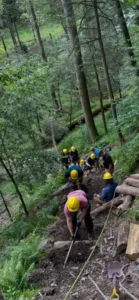 The Jolly Rovers Trail Crew is a volunteer group with years of experience and knowledge in trail building. Ashokan first connected with the crew through Ken Hogan, who made the introduction after the idea of working on the Deer Trail came up in 2024.
When the Jolly Rovers saw the trail, they agreed to take on the project.
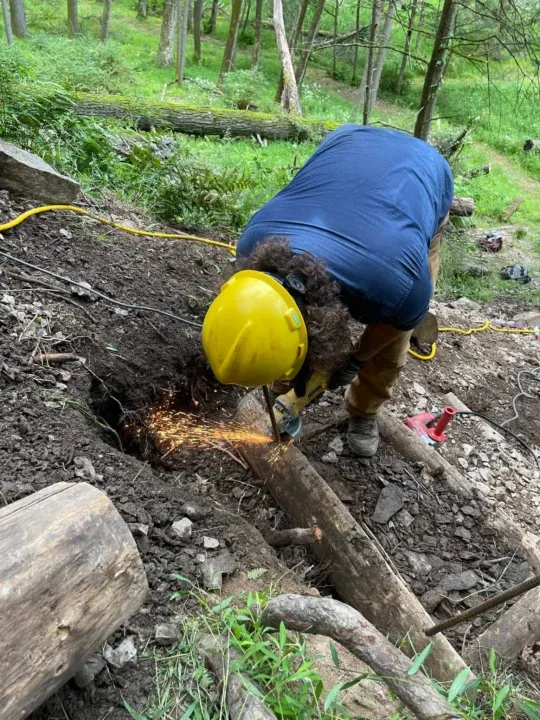
Their work focused on installing a series of stone steps to create safer, more secure footing along the steepest sections. The crew worked alongside Ashokan’s maintenance team, using stone found nearby and black locust logs purchased from a local mill.
Black locust was chosen for its natural resistance to decay and its durability, allowing the trail work to last without relying on pressure-treated lumber or harsh chemicals. Using local stone also helps the finished trail feel like a natural part of the landscape.
The work was anything but easy.
The steep grade and rugged terrain made moving materials one of the biggest challenges. The crew rigged rope lines to help move materials from the landing at the top of the trail. Drilling through the dense black locust proved difficult enough to break numerous drill bits.
And, of course, the weather played a part. Rain slowed the work early in the week, though the crew eventually enjoyed some beautiful days.
Despite the challenges, Joe Martignetti, Ashokan’s Project Manager, was impressed by the Jolly Rovers’ approach.
“They work hard, but they also enjoy themselves,” Joe said. “They love trails and have a desire to improve them.”
More Than Stone and Timber
For Del Orloske, Ashokan’s Educator and Director of Ecological Landscapes, the project was about more than improving a trail.
The Jolly Rovers brought years of shared knowledge and experience, along with a willingness to teach others how to work with stone and other natural materials. Their goal was to create something that would be useful for years to come while sharing their enthusiasm for the outdoors.
Del spent part of the week working alongside the crew and later joined them at their campsite, where the days ended with stories, laughter, and camaraderie.
“What stood out was their supportive nature and willingness to create something that can be enjoyed by young and old,” Del said.
That spirit fits naturally with what Ashokan hopes to create across its grounds: opportunities for people to explore, challenge themselves, learn from one another, and build a deeper connection with the outdoors.
A Special Part of Ashokan
The Deer Trail is also special because of what surrounds it.
The trail passes along a gorge with striking geology, where different types of rock can be seen along the cliff. Old tree roots, unusual ferns, and other plant life add to the experience.
Joe considers it a true gem—and perhaps one of the highlights of Ashokan’s hiking trails.
Once completed, the improved trail will be used by students staying at Ashokan as well as adults and other visitors exploring the property throughout the year. The hope is to create a hike that feels both safe and enjoyable while still offering the challenge of a true mountain climb.
The Work Continues
The Deer Trail is now open again, but the work isn’t finished.
This autumn, Del, Joe, and Ken plan to return to the trail, hopefully joined by additional members of the Jolly Rovers and Ashokan’s Education Department. Together, they’ll continue adding steps and making improvements to create a safer and more enjoyable trail for visitors.
The team plans to continue the work next spring as well, allowing the Deer Trail to evolve over time while preserving the character and challenge that make it such a special part of Ashokan’s landscape.
For now, visitors can once again enjoy the trail—and see the beginning of a project built through collaboration, skilled craftsmanship, and a shared love of the outdoors.