
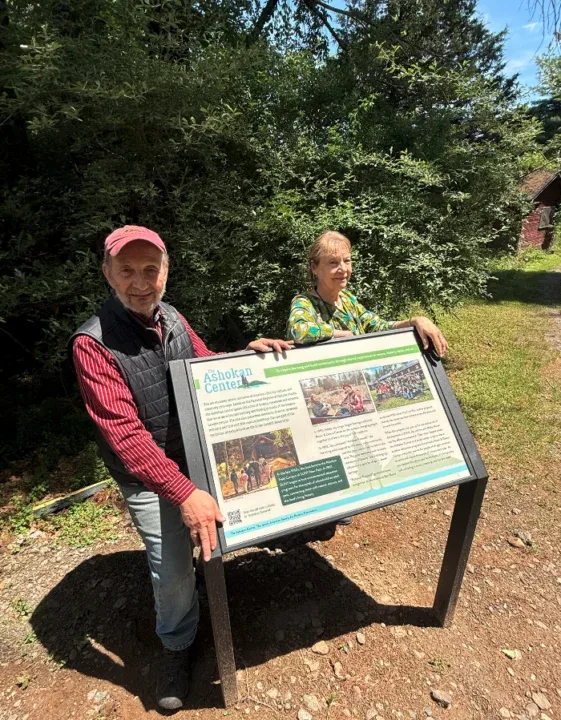
 Recently, visitors arriving at the Ashokan Center may have noticed a new addition near the entrance to campus: a historical interpretive marker that tells the story of this remarkable place and the music that has helped carry its legacy around the world.
The marker was generously donated by the Jewish American Society for Historic Preservation (JASHP), an organization dedicated to preserving and sharing stories that connect history, culture, and heritage. Designed in the style of a National Park Service interpretive exhibit, the installation highlights the unique convergence of nature, history, education, music, and community that defines the Ashokan Center.
Located on 385 acres of forests, meadows, streams, and historic structures in the Catskill Mountains, the Ashokan Center is listed on the National Register of Historic Places. The land carries centuries of history, from its use by Munsee Indigenous communities to the farms, industries, and settlements that shaped life in the Catskills during the 18th and 19th centuries.
The marker also traces the site’s evolution into the Ashokan Field Campus of SUNY New Paltz, where environmental education programs introduced generations of students to the natural world through hands-on learning experiences.
Of course, no telling of the Ashokan story would be complete without music.
Beginning in 1980, Jay Ungar started hosting traditional Music & Dance Camps on the campus, creating opportunities for people to gather, learn, and build community through shared folk traditions. Those camps would ultimately inspire one of the most beloved pieces of American folk music ever written.
In 1982, Jay composed Ashokan Farewell, a waltz inspired by the close of a summer music camp season and the deep emotional connection he felt to the people and landscape of Ashokan. The piece later gained worldwide recognition through Ken Burns’ landmark PBS documentary The Civil War, where its haunting melody became synonymous with themes of memory, loss, longing, and hope.
As Jerry Klinger, President of the Jewish American Society for Historic Preservation, notes in his recent essay on the marker and the song, many listeners mistakenly assume Ashokan Farewell dates back to the Civil War era. In reality, it was written more than a century later by Jay Ungar, who often introduces it as “a Scottish lament written by a Jewish guy from the Bronx.”
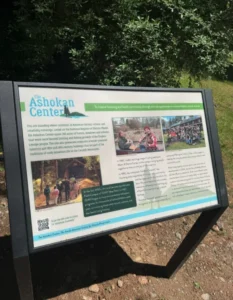 The new marker acknowledges an important part of that story by recognizing the influence of Jay’s Jewish heritage on the composition. As the marker explains:
“The tune resonates with timeless memories of beauty, loss, and longing—influenced in part by Ungar’s Jewish heritage.”
Klinger describes the piece as having “two enduring lives” — one as a beloved folk composition born from the Ashokan community, and another through its association with Ken Burns’ Civil War documentary, where it became part of the emotional soundtrack for millions of viewers.
The installation also tells the story of preservation itself.
When the property faced possible development in 2006, Jay Ungar and Molly Mason led the effort to protect the land and secure its future. Their vision helped transform the campus into the Ashokan Center we know today: a place where outdoor education, environmental stewardship, music, arts, history, and community continue to thrive together.
Today, thousands of visitors come to Ashokan each year for school programs, music and dance camps, concerts, festivals, retreats, and community events. Every person who walks these trails, learns in these classrooms, sings in these halls, or gathers around a campfire becomes part of a story that continues to unfold.
We are deeply grateful to Jerry Klinger and the Jewish American Society for Historic Preservation for helping share and preserve this story through the gift of this historical marker. It serves as a reminder that places matter, history matters, and that the connections forged through music, learning, and community can leave a lasting impact across generations.
As visitors pause to read the marker and take in the landscape around them, they are invited to become part of the living history of Ashokan — a story rooted in the land, carried through music, and sustained by the people who continue to gather here.